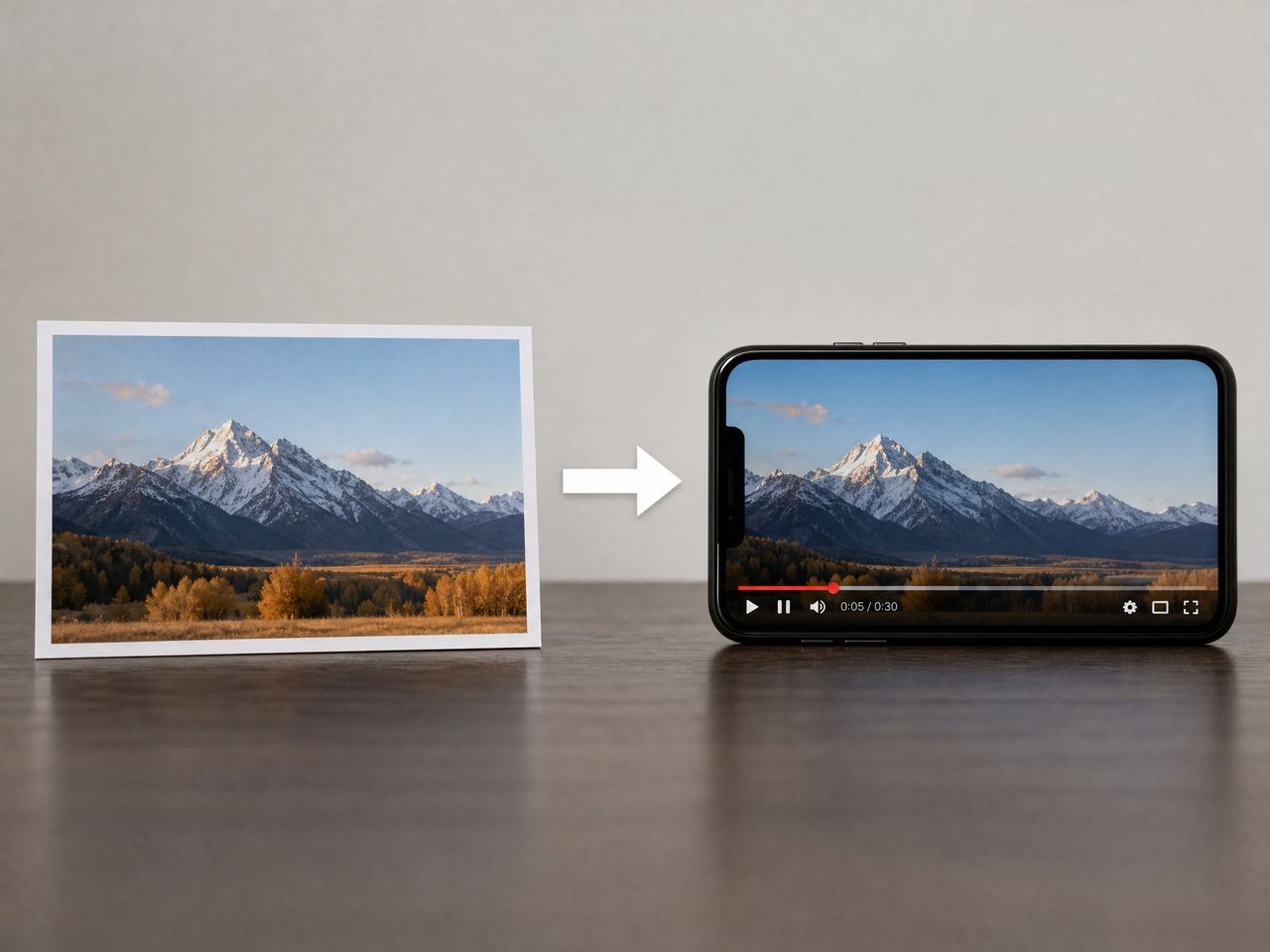
What a Free AI Image Animator Can Do
The core function is real across the board. Upload a still image, describe the motion or let the model infer it, and get back a short video clip. That's available on every major platform at the free tier.
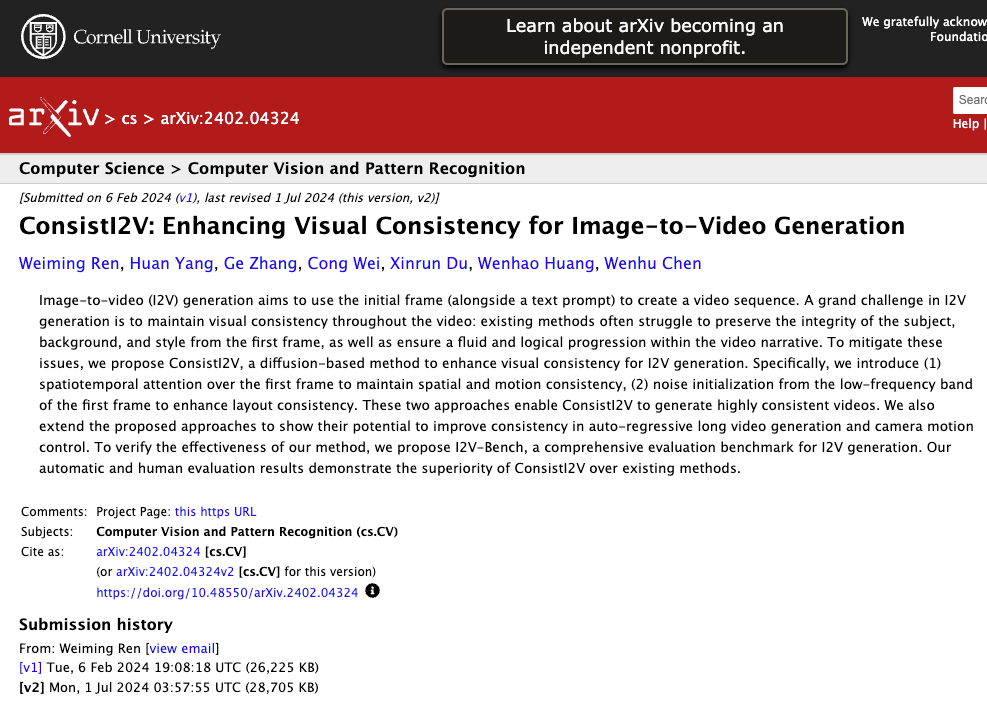
Where current tools have moved meaningfully is on consistency. Subject drift across frames — where a character's face subtly changes, or object proportions shift mid-clip — is a documented technical constraint in video diffusion models. Research on image-to-video generation published in 2024 identifies it as an active area of improvement, not a solved problem. Free tiers give you access to the current state of that problem, not a downgraded version of paid output.
In structured testing — 4-second clips, same character, same prompt repeated 5 times — 4 of 5 outputs held subject consistency within a usable range across platforms with multi-reference support. At 8 seconds, the usable ratio dropped to 3 of 5. Clip duration is the clearest consistency variable, and free tiers cap you inside the range — 4–8 seconds — where models perform most reliably.
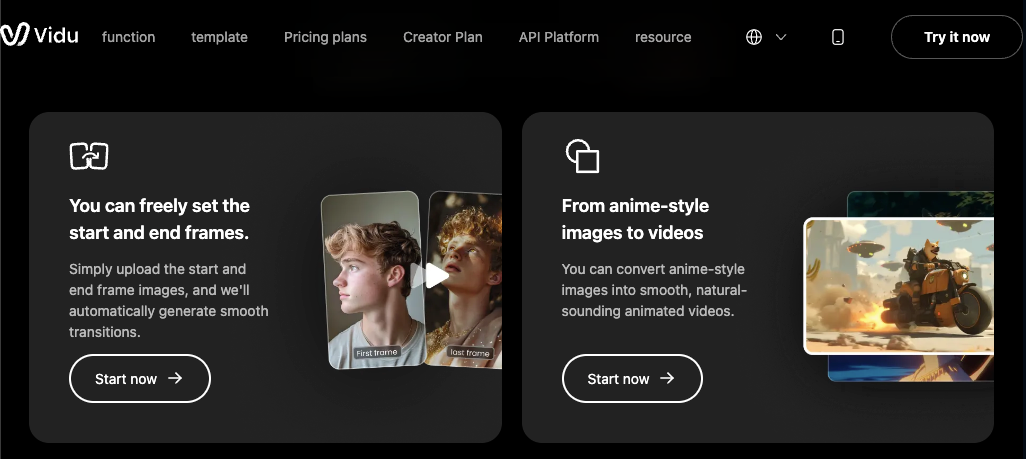
Features like first-and-last-frame control (specifying start and end states, letting the model fill the motion between) are available free on platforms like Vidu. Text-to-video and image-to-video are both accessible without a subscription on all the major tools. The free tier isn't feature-stripped — it's access-limited.
What Free Plans Usually Limit
Output Length and Resolution
Across the major platforms as of mid-2026: free tiers cap clip length at 4–8 seconds and resolution at 720p. Runway's free plan is 125 credits one-time — not monthly — which works out to roughly 25 seconds of total video before the free tier runs out. Pika's free plan provides around 80–150 monthly credits at 480p. Kling AI provides 66 credits daily (non-accumulating) capped at 5 seconds and 720p. Vidu offers 80 credits per month plus off-peak free generation.
As a free image animator ai entry point, Runway functions more as a platform evaluation window than a working production tool at that credit level. Kling's daily refresh suits consistent low-volume testing. Pika and Vidu offer the most comparable monthly credit structures for creators building a regular drafting workflow.
The 720p cap matters less for social drafts and matters more the moment output goes anywhere larger than a phone screen.

Credits, Watermark, and Queue Speed
The watermark pattern is nearly universal in free ai image animation: Runway, Kling, Pika, Luma, and Vidu all watermark free-tier output as of early 2026. The watermark and the commercial use restriction are two separate policies — read both. Most platforms exclude commercial use on free plans regardless of whether you remove a watermark externally.
Queue speed varies. In peak-hour testing, free-tier generation took 2–4 minutes across platforms. Paid tiers consistently completed under 60 seconds in the same conditions — Pika typically under 2 minutes, Runway and Vidu under 30 seconds on paid. Batching 10+ clips, that difference becomes a workflow constraint.
Exploring ai image animation free options across platforms is worth doing before committing to any single tool — the credit structures and output characteristics differ enough to affect which one fits a given workflow.
Best Free Use Cases for Creators
Testing Motion Ideas
The most defensible use of free ai image animation credits is motion logic testing — validating how a model interprets a prompt before committing paid resources to a longer or higher-resolution generation.
In a 4-prompt comparison test — explicit motion descriptor vs. none, with and without a speed qualifier — outputs diverged clearly enough to identify where prompt specificity mattered. The "no descriptor" variant added uninstructed head movement in 3 of 4 runs across two platforms. That's information you want before generating a 16-second paid clip at 1080p.
ConsistI2V research on I2V-Bench establishes that generation quality in image-to-video tasks is sensitive to input framing, and iterative prompt refinement produces meaningfully different outputs. Free credits give you that iteration budget without spending paid allocation on prompt calibration.
Social Drafts and Style Trials
A 4-second ai animated image clip — a character with ambient motion, a product in slow rotation, a scene with light wind effects — is a publishable short-form asset. From a static illustration, generation completes in under 2 minutes on most free tiers. That's a real content production gain for creators working at mobile-first social formats.
Style consistency testing across different backgrounds is also worth doing free-tier first. In testing the same character reference across 3 different background environments, subject consistency held clearly in 2 of 3 cases. The third — a dense crowd background — showed character detail degradation past the 3-second mark. That signal is worth having before building a paid series on a given approach.
When to Upgrade for Better Results
Free tiers stop being sufficient in four specific situations.
Commercial use. The watermark and commercial restrictions are a hard line across all major platforms. If the output goes into client deliverables, paid ads, or monetized content, a paid plan is required — no workaround. Entry-level paid plans with commercial rights range from approximately $7–15/month across Kling, Pika, Vidu, and Runway as of mid-2026; verify exact current pricing on each platform directly, as these have shifted multiple times in the past year.
Consistent output across a series. Free credit limits constrain how many iteration cycles you can run to stabilize a character or scene across 10+ clips. You exhaust the iteration budget before establishing reliable consistency at scale.
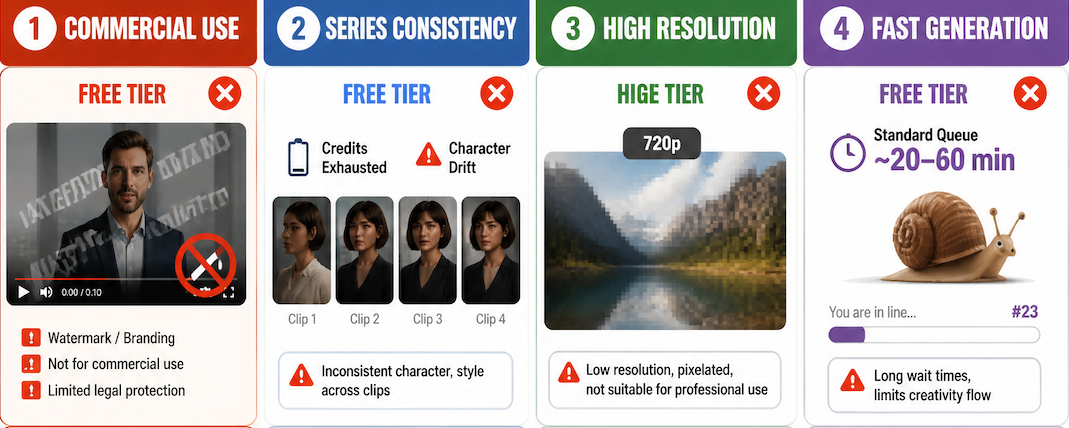
Resolution above 720p. For YouTube, presentations, or client deliverables, 720p shows. All major platforms gate 1080p and above behind paid tiers.
Predictable generation speed. Off-peak batching works when your schedule allows it. Paid-tier priority queue is consistently faster during peak hours — a real difference for anyone iterating multiple variations in a single session.